Start with the current edition
Open the official event page and check the edition, distance and start wave that apply to you. A search result may lead to last year’s guide, while a multi-distance event can put several different arrangements in one document. Save the relevant file with its date in the filename. If the guide has not yet been published, distinguish confirmed information from details carried over from an earlier year.
List the commitments that cannot be moved: bib collection, any required checks, transport departure, entry to the starting area and the start itself. Do not turn each published time into an arrival target. Some are closing times, and others describe a period rather than a single appointment. Mark them accordingly so that a collection deadline does not quietly become your planned arrival time.
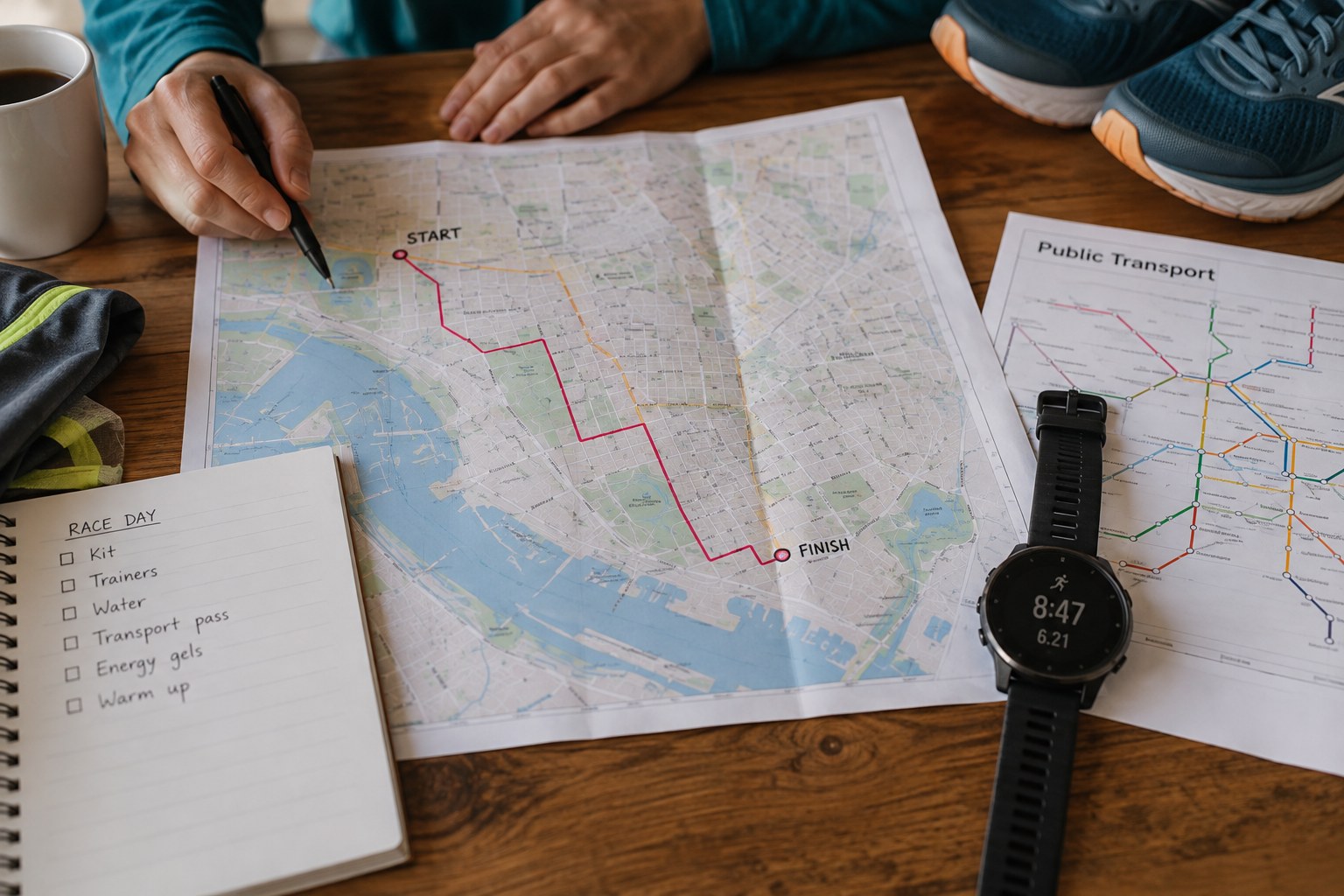
Draw the journey between event locations
A race village, bib collection hall, start gate and finish can have different addresses. Put each one on a map and inspect the connection. A hotel described as near the race may be near only one of those places. The straight-line distance also says little about barriers, river crossings or entrances on the opposite side of a large venue.
Check the organiser’s transport instructions before trusting a normal driving route. Road closures may prevent a taxi or private car reaching the entrance you have selected. If an event shuttle is involved, confirm whether it needs a separate booking and which direction it runs. A shuttle to the start does not necessarily provide the reverse journey at a time convenient for you.
Build a return plan with breathing room
Work backwards from your proposed train or flight. Include leaving the finish area, finding your bag, changing clothes and reaching the station or airport. Then ask what happens if the event runs late or your own outing takes longer than expected. A return that works only if every step goes perfectly is a fragile plan, especially when the course finishes away from public transport.
For a shared trip, write down whose booking depends on whose finish. Supporters may prefer a separate return option instead of waiting for an uncertain moment. If you are staying overnight, check the accommodation’s arrival and departure arrangements independently of the event. Do not assume a race partnership changes ordinary check-in rules unless the booking explicitly says so.
Read the conditions before choosing the cheapest fare
Look at entry cancellation, transfer and deferral terms, then read the travel provider’s own terms. They are different contracts. A race postponement does not automatically make a non-refundable ticket refundable, and a flexible train ticket does not make an event entry transferable. This is a reason to understand the choices, not a claim that one expensive option is always necessary.
Keep a short list of unresolved points and ask the appropriate organisation a precise question. For example, ask whether collection closes at a stated time or whether a listed shuttle requires advance reservation. Avoid asking the organiser to approve an entire personal travel itinerary when the uncertainty concerns one service.
Finally, keep offline copies of the addresses, confirmations and contact details you will actually need. Recheck the official event updates shortly before travel. Your saved guide is a planning record, not evidence that no later change has occurred. A few clearly identified checkpoints make it easier to revise the trip without reconstructing every decision from scattered messages.