Describe an ordinary delay
Imagine a plausible interruption rather than an extreme expedition: a missed turn, a companion walking the last section, a closed path or a longer wait for transport. Ask what changes when the outing takes longer. The answer may involve light, temperature, communication, food or the final journey, not just another item of equipment.
Use the route to decide which delays matter most. A short loop passing the start offers different options from a point-to-point route over a hill. If the plan becomes difficult after a modest delay, simplify it before adding kit. Carrying more does not fix a route with no realistic return once the last bus has gone.
Keep essentials useful when movement stops
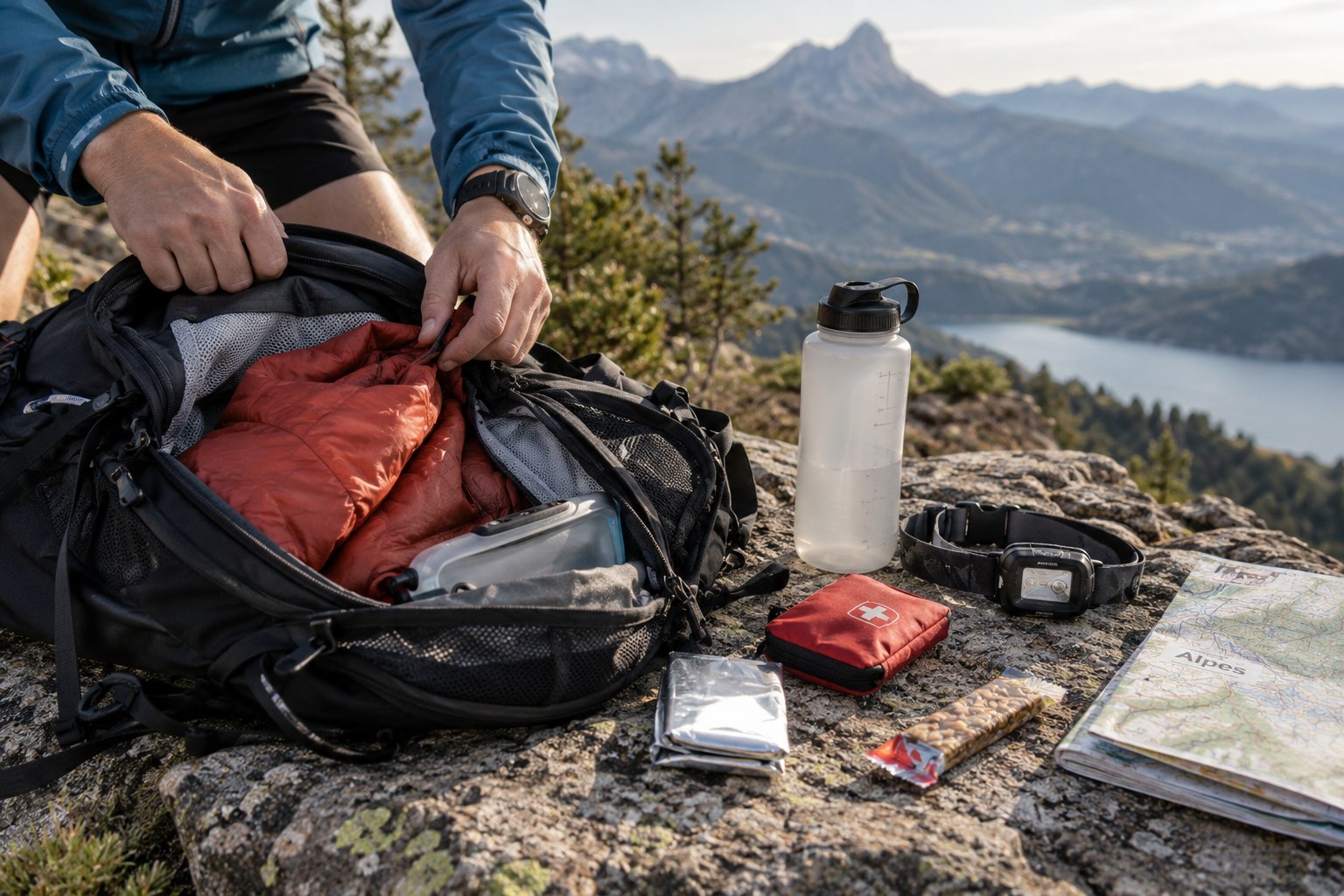
Think about the clothing you would want while waiting or walking slowly. Put the relevant layer somewhere accessible and protect it from wet items. A jacket buried beneath everything may be present on the list but awkward to use at the moment it is needed. Practise putting it on with the vest and any gloves you plan to wear.
Check whether the expected return could approach darkness if the outing runs late. Prepare appropriate lighting for that possibility and know how to operate it. Do not assume the phone can provide navigation, communication and sustained path lighting without competing demands. A backup arrangement should be considered in relation to the actual terrain, not reduced to a spare object whose use you have never tried.
Keep food and drink planning connected to the longer scenario. Avoid relying on an unverified shop or water point remaining available when you arrive late. If your plan depends on a service, check it and retain a realistic alternative. This is an organisational check, not a reason to turn a short local outing into a heavily loaded trip.
Make communication possible to organise
Tell your contact the expected route and what you will do if it changes. Save useful numbers and the starting location where they can be found without a network search. Protect the phone from moisture while keeping it accessible at a safe stop. Check any charging accessory with the actual device and cable before packing it as a solution.
Do not assume that carrying a charged phone establishes coverage. Know the route’s obvious return options and keep an appropriate map backup. If travelling with companions, avoid placing every essential item and all route knowledge with one person. Discuss who has the map, light and contact information so that the group understands its resources.
Check the exit beyond the trail
A delayed finish may change parking access, public transport or an arranged lift. Read the relevant times and conditions before departure. If another person is collecting you, agree how a delay will be communicated and where they can wait. A vague pickup location can add unnecessary time after the running is already finished.
Carry what you need to reach home, including access to payment or tickets as appropriate, without assuming a particular shop will be open. Keep keys secure and separate from a pocket you will repeatedly empty. These small arrangements are easy to overlook because they do not look like trail equipment, yet they determine whether finishing the route actually finishes the problem.
Try the packed arrangement
Load the vest and walk or jog briefly near home. Check that the added layer and lighting do not make the usual items inaccessible or create uncomfortable movement. Remove the jacket, reach the phone and locate the light without spreading everything on the ground. If the packing only works while the bag is open on a table, revise it before the outing.
Afterwards, keep the list proportional to what you learnt. Remove irrelevant extras, replace an unreliable arrangement and retain the items that support a realistic delay. The aim is a route and kit combination with usable options. It is not a promise that equipment can make every situation manageable, nor a requirement to continue because you believe you have packed for everything.