Choose the agreement before the route
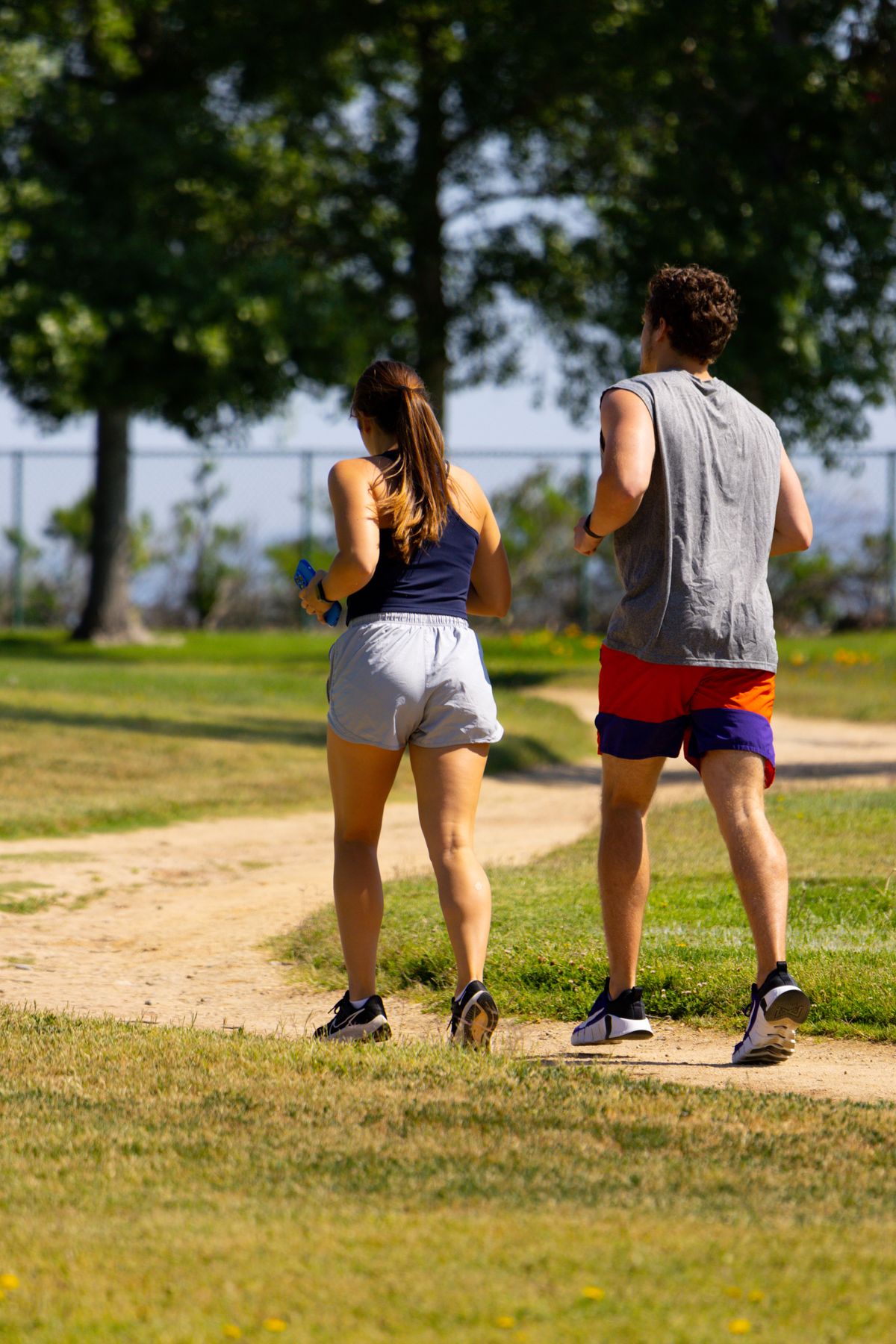
If the purpose is conversation, agree that the pace will allow both people to speak comfortably. The runner who usually moves faster needs to accept that this is the plan, rather than repeatedly inviting the other person to catch up. A friendly promise to go slowly is less useful than a clear agreement about walking, stopping and the length of the outing.
Ask about the longest time each person wants to be out, including the return. Do not choose a route around the faster runner's usual distance and assume the slower runner can complete it with encouragement. A modest shared route leaves room for a pleasant finish rather than an unplanned extension.
Use the landscape to separate and rejoin
A short, visible loop can let one person add an extra circuit while the other continues at their own rhythm. This only works when the meeting place and direction are clear. Avoid arrangements where someone waits alone at an uncertain woodland junction or feels obliged to keep moving to prevent the other person getting cold.
On an open park circuit, you might agree to meet at the entrance after a fixed period. Each person can then choose how to use that period. Check the time and the exact location before separating; 'near the car park' is not precise when there are several entrances. Carry a way to contact each other if the plan changes.
Agree what happens when the plan changes
Imagine that one person wants a relaxed half-hour outing and the other has a longer session in mind. A workable arrangement could be a shared opening section followed by a clearly agreed separation at the park entrance. The longer run then belongs to the person who chose it; the other person does not need to wait for its completion.
Discuss this before setting off, including the journey home. If you share a car, splitting the run creates an additional waiting arrangement. If you each have an independent way back, the same split may be straightforward. Running compatibility is partly a transport and timetable question, not just a difference in speed.
Also agree on a simple phrase that means the current pace or route no longer works. The response should be a practical adjustment rather than a debate about whether the person could manage a little more. Walking together to the next suitable junction can create space to decide without making the conversation happen while someone struggles to keep up.
When inviting a less familiar running partner, offer the proposed duration and purpose in the invitation. A vague promise of a short run allows two different expectations to survive until the outing is already under way.
Keep feedback useful
Ask a neutral question such as whether the pace still suits the outing. Avoid comments that make one person responsible for the other's training, including apologies for being slow or praise for keeping up. The faster runner can choose a separate demanding session another day. The slower runner does not owe a harder effort in exchange for company.
Finish with enough time for the return you agreed. If the arrangement did not work, name the practical issue: too many stops, a route too narrow for conversation, or different expectations about distance. That gives you something to change next time. A shared coffee after separate runs can be a better social arrangement than repeatedly forcing two incompatible sessions into one.