When the available window is the limit
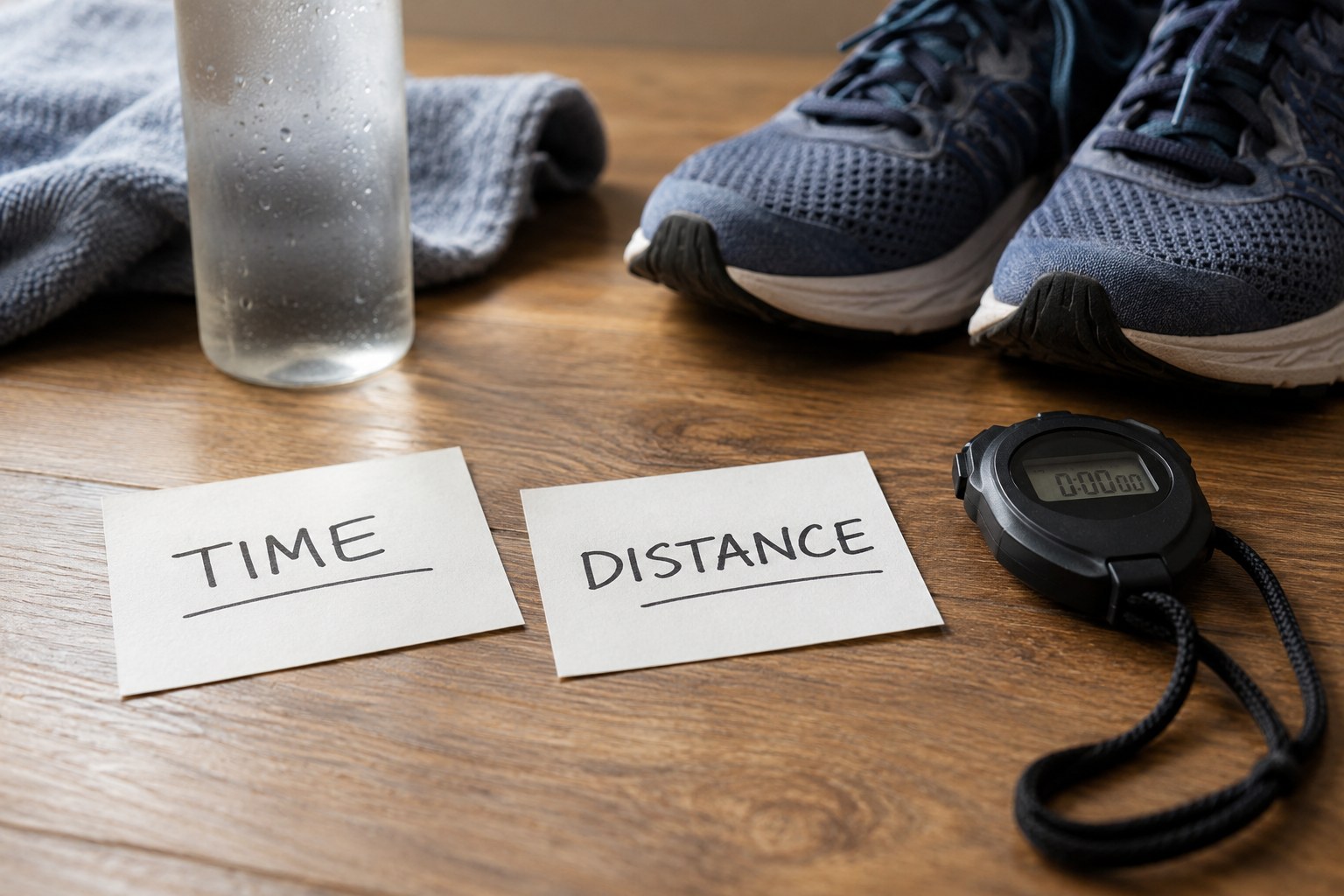
Time is often the clearer starting point when an outing must fit around work, family or transport. You can plan a short route with a known return and decide in advance when to turn. The aim is to finish within the available window, not to cover as much ground as possible before the timer ends.
Count the whole outing honestly. If you intend to walk the beginning and the return, those minutes still occupy the calendar. An app's moving time may omit stops while your appointment does not. Set the latest return time from the real clock and allow for crossings rather than relying on a watch's automatic pause feature.
A time-based outing also allows different paces on different surfaces without treating the slower section as a failure. However, it does not remove the need to understand the route. Being halfway through the planned time does not guarantee that you are halfway home if the return is uphill or has more junctions.
When a specific route is the point
Distance can be useful when you want to complete a familiar circuit or understand the scale of an event. It gives the outing a defined geographical shape. You know which bridge, park entrance or path brings you back, and you can prepare for that route rather than repeatedly checking how many minutes remain.
The distance should still sit within a sensible time allowance. A five-kilometre route on open pavement and one on a rough hillside are different undertakings. Do not take a familiar road-running pace and assume it predicts an unfamiliar trail. Read the surface, crossings and elevation before using the length to estimate your return.
If the route cannot be shortened, decide whether that commitment suits the day. A distance target is less flexible when the only way home is to finish the entire circuit. A nearer loop may offer a better choice even when its number is less satisfying.
Use one measure to lead and the other to constrain
You do not have to choose one measure forever. For a weekday outing, time might lead while a familiar short route keeps navigation simple. At the weekend, a chosen circuit might lead while a latest return time limits any extra exploring. The important point is knowing which boundary takes priority.
Imagine having forty minutes available from leaving home to returning. You could choose a nearby loop and keep an earlier exit available. If a crossing takes longer than usual, the exit preserves the time boundary. By contrast, someone visiting a particular riverside circuit may accept a variable duration but should still check whether transport and daylight allow it.
Avoid changing the rule halfway through simply to make the activity record look complete. Adding a street to round up the distance after the planned finish is a new decision, not a requirement imposed by the original outing. The same applies to running until a timer reaches a neat number after you have already returned comfortably.
Review whether the goal helped
After a few outings, ask what the chosen measure improved. Did it reduce rushed returns? Make routes easier to organise? Help you stop comparing speed? If it mainly created new pressure, change the way you use it. A goal can be a planning aid without becoming a test.
Keep the other observations that the number cannot explain. A route with several road crossings may be inconvenient despite a manageable distance. A short run can use its available time well without feeling hurried. Choosing a measure is about making your intention visible; it does not define the value of the outing or require every future run to follow the same format.
Use a separate note for routes that have a fixed closing time. A park gate can make the return deadline more important than either the running duration or distance. Check the current opening information and choose an earlier exit if there is uncertainty. A route goal should never depend on finding an unofficial way out after access closes.