Do not infer protection from appearance
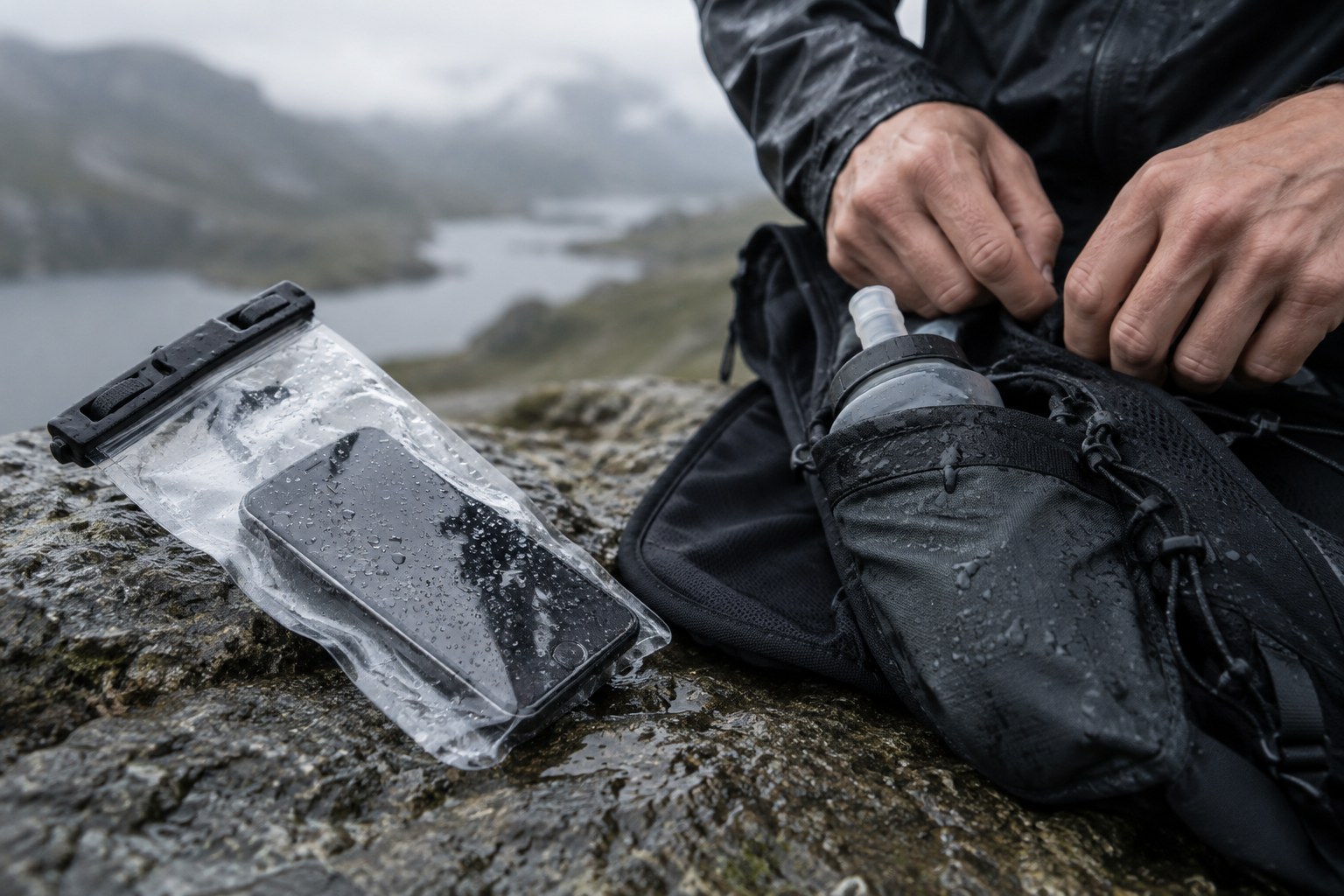
Check the phone’s and case’s current care guidance and the pocket’s stated protection. A zip, coated fabric or tight fit does not by itself establish waterproofness. Think about rain reaching the opening, a wet jacket being packed beside the phone and the possibility of taking the device out with wet hands. Avoid planning around an unsupported assumption that one layer will solve every situation.
Choose a protective pouch or compartment appropriate to the conditions and device. Check its closure and inspect for damage before loading it. Test handling with a harmless stand-in if needed, rather than deliberately soaking the phone to prove the arrangement. Keep the case and pocket within their stated uses.
Make access a stopped task
Put the protected phone in the chosen pocket and wear the loaded vest or belt. Stop in a safe place and retrieve it. Can you open the closure without pulling other items out? Can you put it back and confirm that the closure is secure? Practise with gloves if they are part of the planned clothing.
Notice whether the phone presses against you, swings or blocks another essential item. A rear pocket may protect it well but require removing the vest for each map check. That can be acceptable if you plan for it; it becomes awkward when you expect constant access. Match the location to the actual use rather than simply choosing the largest pocket.
Test the wet-weather sequence without wetting the device
Use a dry rehearsal to identify every exposure point. Remove the protected phone, open only what must be opened, look at the needed information and close it again. Notice whether the pouch must be placed on the ground or held with the same hand that operates the screen. If the sequence needs more hands than you have, change the storage or choose a place where the vest can be safely removed.
A screenshot of the next route decision may reduce repeated searching, but it should retain enough context to remain useful and does not replace the wider map. Keep essential information accessible without relying on a new download. If the pouch prevents comfortable operation, plan to consult the phone only during sheltered stops instead of abandoning the protection while continuing through rain. Match the handling plan to the route’s actual opportunities to stop, not to an ideal dry bench that may never appear.
Keep the screen from becoming the route
Download the information you need and organise it before leaving. Frequent searching makes the phone stay outside its protection for longer. Consult it while stationary, then secure it before moving on. If conditions make handling difficult, use a safer stopping place or reconsider the route rather than trying to manipulate a slippery device on uneven ground.
Afterwards, check the pocket and protective layer for retained moisture and follow the device’s care instructions if it became wet. Let appropriate accessories dry before storage. Record any awkward step, such as a closure that was difficult with gloves. A dependable arrangement is one you can use calmly, not merely one that fits the phone while everything is dry on a table.