Find the authoritative version
Start with the organiser’s official runner information and regulations. Confirm the year, race distance and any category that changes the requirements. Save the relevant documents with their date or version. A search result, old email or friend’s photograph may refer to a previous edition, so use it to locate the current source rather than treating it as the final list.
Check whether the organiser has separate weather-dependent additions and when those decisions are communicated. Ultra-Trail Snowdonia’s official kit page is one example where the basic list and weather-kit instructions must be read together. Do not generalise that event’s requirements to another race; the lesson is to identify all the documents that govern your own entry.
Turn each requirement into a checkable item
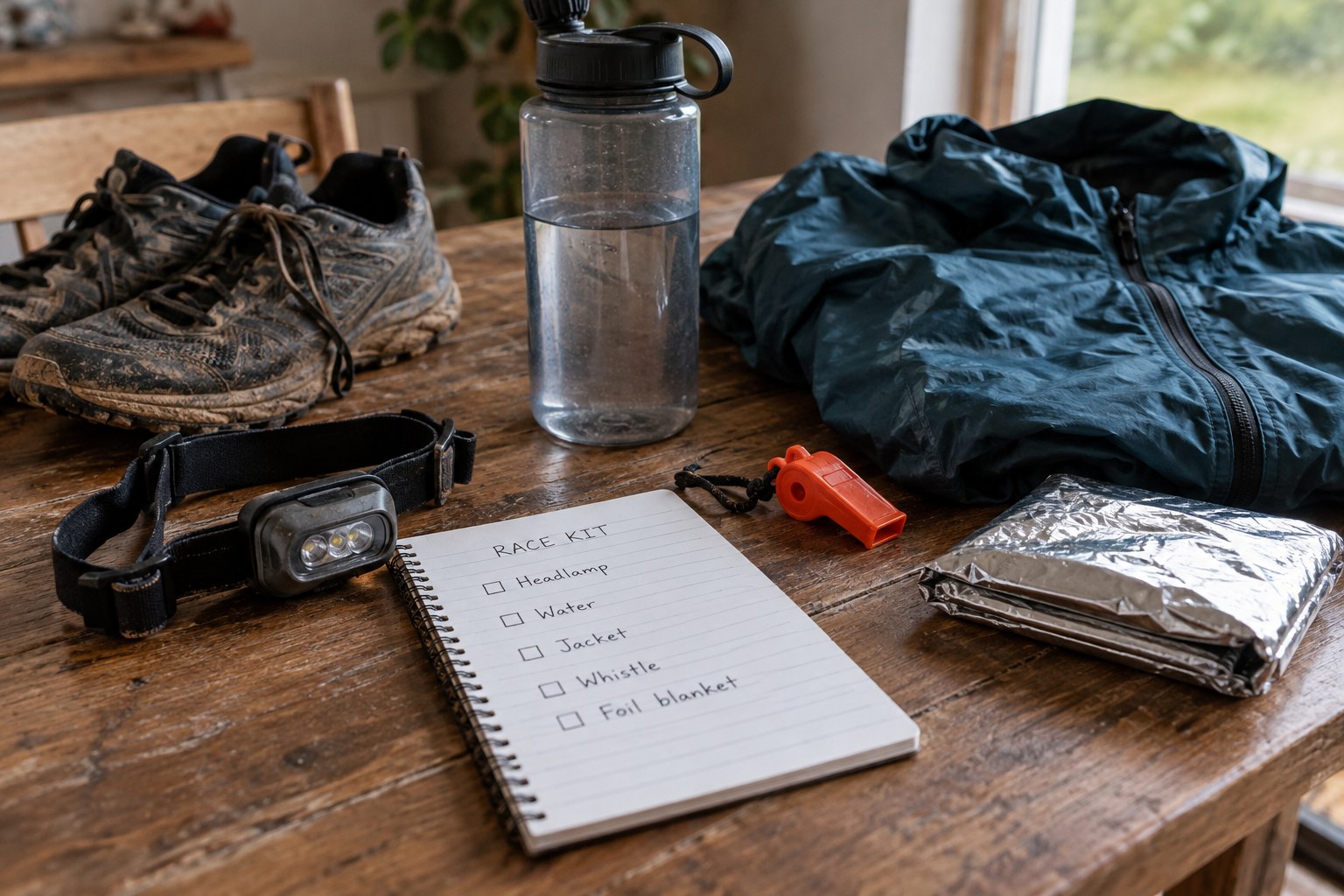
Write one line for each required item, preserving any specification that affects acceptance. A generic word such as jacket may omit a hood, material or construction requirement stated by the organiser. Copy the criterion into your private checklist accurately, then identify the actual item you intend to carry. Do not substitute a lighter product solely because its name sounds similar.
Use separate columns or notes for owned, checked, packed and any question awaiting clarification. These are different states. Owning a lamp does not establish that it meets the rule, and a compliant item at home is not packed. Keep uncertainty visible until the organiser’s published information or a direct answer resolves it.
Ask a precise compatibility question
If a requirement is ambiguous, describe the product and quote the specific criterion when contacting the organiser through its published channel. Include the relevant model information or photograph if requested. Ask whether that item meets that rule for that race, rather than asking whether your kit is generally good enough. Retain the response with the checklist.
Do not let a retailer’s claim replace the organiser’s interpretation. A product may be suitable for running without meeting a particular event specification. Likewise, another participant passing a check in a previous year does not establish acceptance now. Resolve important questions early enough that changing an item remains possible without a hurried purchase on race morning.
Pack the complete load and use it
Once the required items are identified, load the vest and practise accessing them. Check how the jacket, spare lighting, food and other equipment fit together. Follow any rule about carrying items throughout the event or keeping them in a particular pack. Do not plan to leave something at an aid station unless the organiser explicitly permits that arrangement.
Add personal items that the route and your needs require, even if they are not named on the minimum list. The compulsory list is not a personalised packing service. Test the actual load on an appropriate local outing, within the limits of the equipment and your plan, and correct rubbing, inaccessible pockets or incompatible components before race day.
Recheck close to the start
Review official updates at the time specified by the organiser. If an additional kit is activated or a requirement changes, update the checklist and verify the physical item rather than only editing the document. Keep the communication channel accessible during travel. Do not assume that a decision made while packing several days earlier remains current.
Use a final lay-out check before loading and another presence check after any unpacking. Charge electronics, inspect closures and confirm quantities or capacities where the rules specify them. Keep the checklist readable enough to use when tired from travel. A clear final check is more reliable than repeatedly remembering the list from scratch.
After the event, retain the structure but archive the race-specific requirements with their year. Reuse the method for another event, not the old answers. That preserves the value of the preparation while preventing a well-organised outdated checklist from looking more authoritative than the next organiser’s current rules.